

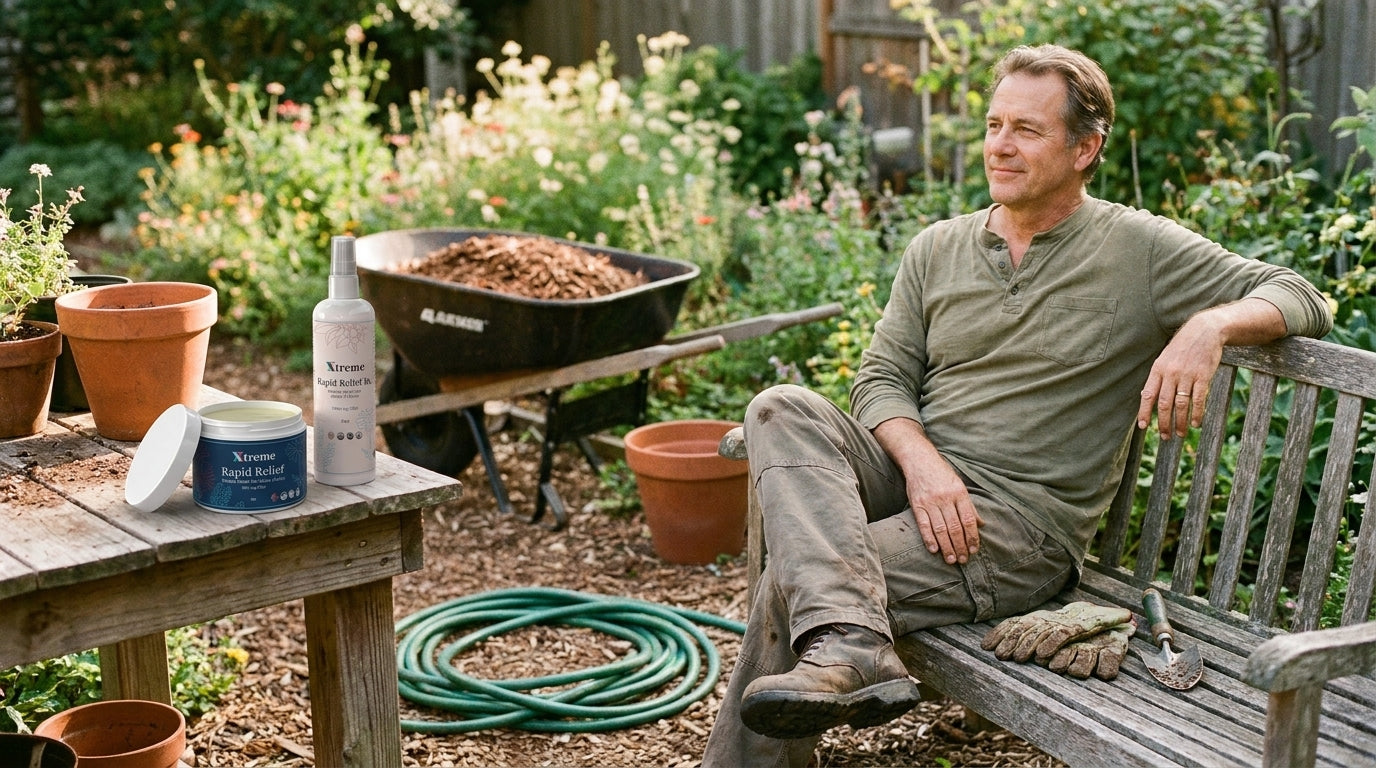
It's Saturday morning. The lawn needs mowing, the flowerbeds are calling your name, and you've got a fresh bag of mulch waiting in the garage. Six hours later, the yard looks great and you can barely stand up from the couch. By Sunday morning, your back is locked, your hamstrings are screaming, and you're moving like you aged twenty years overnight.
Welcome to weekend warrior recovery, the most underrated topic in adult fitness. Most people over 45 deal with this exact pattern and most of them assume the only fix is to just do less. That's the wrong takeaway.
Here's what the research actually says about yard work, gardening, and weekend physical activity for adults over 50: it's good for you. A Baylor College of Medicine study tracked over 2,600 adults and found that people who gardened had a 29% lower risk of frequent knee pain and a 25% to 29% lower risk of knee arthritis compared to people who didn't. That activity is doing real work for your joints. The problem isn't the activity. The problem is what happens after.
This guide covers how to set up your body for a long Saturday in the yard, how to recover smart so Sunday doesn't feel like punishment, and the simple daily habits that let you keep doing what you love without paying for it for three days.
Why Weekend Warriors Get Hit Harder After 45
When you were 25, you could push through six hours of yard work and feel sore for a day. The same six hours at 55 can knock you out until Tuesday. Three things change that explain this.
First, muscle recovery slows down with age. According to the National Institutes of Health, adults over 50 working physically demanding tasks report higher rates of muscle strain and longer recovery times. Your tissue still bounces back but it takes more time and more support.
Second, the activities themselves are sneakier than they look. Digging, bending, hauling, weeding, and squatting work muscle groups you might not normally challenge. You're not just using your back. You're using forearms, knees, glutes, calves, hamstrings, shoulders, and hands all at once. Six hours of that is a real workout, even if it doesn't feel like one in the moment.
Third, the warm-up usually doesn't happen. Most people walk straight from coffee to the shovel. Your tissues are cold, your joints are stiff, and the first hour of work is harder on your body than the last.

The Three Phases of Weekend Warrior Recovery
Smart weekend warrior recovery breaks into three phases: before, during, and after. Each one matters, and none of them takes more than five minutes.
Phase 1: Before You Start (5 Minutes)
Don't skip this part. Five minutes of warmup spent before the work begins saves you two days of soreness on the back end. The goal isn't a workout. The goal is to wake up the tissue and joints you're about to ask a lot of.
A simple pre-yard work warmup looks like this. Take a brisk walk around the yard for two minutes. Roll your shoulders forward and back ten times each. Do ten slow squats holding onto a chair or a fence post for balance. Stretch your hamstrings by bending forward and reaching toward your toes for thirty seconds. Open and close your hands twenty times to wake up your grip.
If you've got a problem area that already gives you trouble (a stiff lower back, a cranky knee, achy hands), this is the moment to pre-treat it. A thin layer of the Xtreme Rapid Relief Balm massaged into the spot before you start gives that area a head start. The cooling-to-warming effect helps the tissue loosen up so the first hour of work doesn't lock you up worse than you started.
Phase 2: During the Work (Micro-Breaks)
The biggest mistake weekend warriors make is going for the whole job at once. Three straight hours of weeding before lunch is asking too much of a body over 50. Break the work into thirty-to-sixty-minute chunks with short transitions between them.
Use those transitions as movement snacks. Stand up. Walk fifty steps. Shake out your hands. Roll your shoulders. Hydrate. These two-minute resets keep your tissue from locking into one position for hours, which is what creates most of the next-day soreness.
If you want more on this approach, see our full guide to movement snacks, which covers how small bursts of motion add up to real recovery benefits.
Also vary the work. Don't spend three hours kneeling, then three hours raking. Switch positions and tasks every thirty minutes if you can. Your body recovers faster when no single muscle group takes the full hit.
Phase 3: After You Finish (5 Minutes)
This phase is the difference between waking up sore on Sunday and waking up like you got hit by a truck. Five minutes of intentional recovery work after the yard work is done resets your tissue while it's still warm, before stiffness sets in.
Take a cool shower or rinse your legs with cool water for thirty seconds. Drink a full glass of water. Sit down on the porch or the couch and reach forward for a slow hamstring stretch for one minute. Roll your shoulders ten times. Open and close your hands twenty times.
Then apply broad-area recovery support across the areas that worked hardest. The Xtreme Rapid Relief Spray is built for exactly this. Spray across your lower back, hamstrings, calves, and shoulders. The broad coverage hits the zones your hands can't easily reach, and the cooling-to-warming effect helps the tissue release while it's still warm from the activity. No bending, no scrubbing in cream, no mess.
For focal trouble spots, follow up with the Rapid Relief Balm on knees, hands, or the small of the back. Massage a thin layer into the area for thirty seconds. The combination of broad-area Spray plus Balm covers everything your yard work asked of you.

The Sunday Morning Test
How you set up Sunday morning is the real measure of whether your recovery worked. If you wake up stiff but able to move within ten minutes, you did it right. If you wake up and can't bend over to put on socks, the recovery routine needs work.
On Sunday morning, before your feet hit the floor, do ankle circles in bed for thirty seconds each direction. Roll your shoulders ten times. Reach overhead and stretch toward the ceiling. Sit up slowly. Stand up using your legs instead of your back. Drink a full glass of water before you do anything else.
Then apply Rapid Relief Spray again to whatever's still talking to you. Mornings after big yard work days are when broad-area coverage matters most. You don't want to be twisting around trying to reach your lower back with stiff hands.
If hands feel tight, the Xtreme Rapid Relief Roll-On is a clean option for morning hand recovery. The rollerball delivers product and pressure at the same time, which makes it easy to refresh tight forearms and the back of the hand without bending down for a massage. Roll across the tight areas for thirty seconds and you're done.
Why Daily Habits Matter More Than Weekend Heroics
Here's the truth most weekend warriors don't want to hear. The single biggest factor in how well you recover from a big yard work day isn't what you do that Saturday. It's what you've been doing the rest of the week.
Adults over 50 who maintain daily movement and recovery habits handle weekend exertion dramatically better than adults who are sedentary all week and then explosive on Saturdays. This is the whole logic behind movement snacks, daily foot care, and consistent recovery support.
If your weekday routine is mostly sitting, those eight hours a day at a desk are setting you up for the Sunday morning struggle. Building a daily recovery rhythm through the week, even just five to ten minutes of intentional movement and recovery support, changes how your body responds to physical weekends. The yard work isn't the test. The week leading up to it is.
This is also why the Rapid Relief line is built for daily use rather than just acute moments. The products work best when they're part of your week, not just emergency tools after you overdid it.
When to Pull Back vs Push Through
Knowing when to stop is part of staying in the game long-term. Mild soreness, tight muscles, and general fatigue are normal after a big yard work day. They mean your body did the work and is now repairing itself. These respond well to daily recovery support and another day or two of normal activity.
Per Cleveland Clinic guidance on back strain recovery, sharper or more localized pain is a different signal. If you experience sharp pain that hurts to put weight on, numbness or tingling in an arm or leg, swelling or bruising in a specific spot, or pain that doesn't improve after three to four days of rest, that's a stop-and-see-someone signal. A chiropractor, orthopedist, or primary care doctor can help you figure out whether you've got a strain that needs more time or something that needs treatment.
The point of a recovery routine isn't to power through serious pain. It's to make sure normal weekend exertion doesn't become serious pain in the first place.
The Bottom Line
Yard work and gardening are good for you. They keep you active, they get you outside, they give you a sense of accomplishment, and the research shows they protect your knees over time. The activity isn't the problem. The recovery is where most people drop the ball.
Five minutes of warmup before you start, micro-breaks every thirty to sixty minutes during the work, and a focused five-minute recovery routine after you finish. That's the whole framework. Layer in daily recovery support during the week and the weekend stops costing you Monday.
That's what the Rapid Relief line is built for. Clean, fast-acting recovery tools designed to fit into real life and keep you doing the things you love. Browse the Rapid Relief lineup to find the pieces that fit your weekend warrior recovery routine.
FDA Disclaimer: These statements have not been evaluated by the Food and Drug Administration. These products are not intended to diagnose, treat, cure, or prevent any disease.
Share:
Tired Feet After 50: The Daily Recovery Routine Podiatrists Recommend
Hand Recovery After 50: Daily Care for Stiff Joints, Tired Grip, and Working Hands