

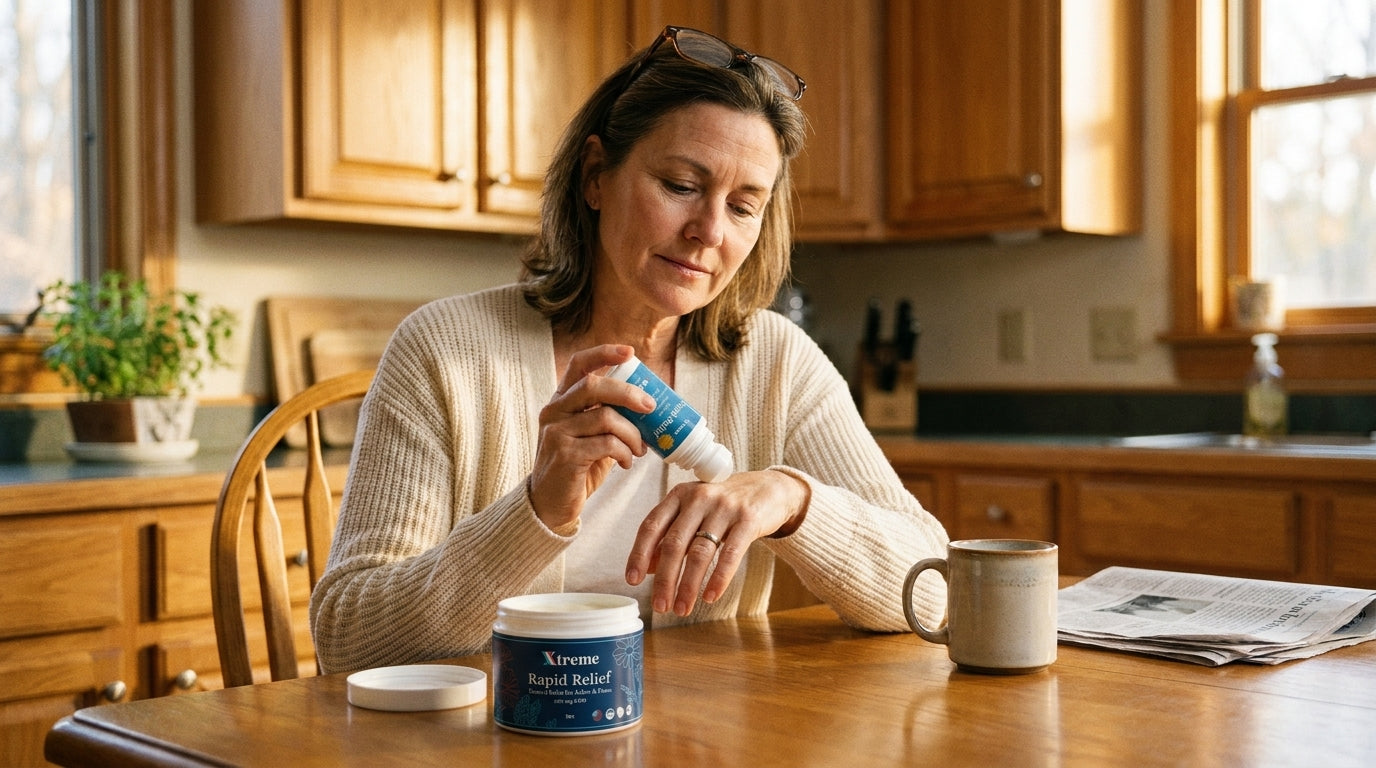
You wake up and your hands feel like they belong to someone else. Tight. Stiff. The fingers don't quite want to close all the way. You shake them out, you flex them, and after a few minutes they loosen up. By the time you're pouring coffee, they feel mostly normal again. But that morning stretch of stiff, awkward hands has become a regular thing, and you're starting to wonder if it's the start of something bigger.
Hand stiffness after 50 is one of the most common but least-talked-about parts of getting older. Your hands work for you all day, every day, and they wear out faster than most people realize. The grip you had at 35 is not the grip you have at 55. The way your fingers move when you button a shirt, open a jar, or hold a coffee mug has gotten just a little bit harder and most people don't notice until they actually pay attention.
Here's the good news. Your hands respond well to consistent daily care. A simple hand recovery routine can take most of the morning stiffness away and help you keep grip strength and mobility for the decades ahead. This guide walks through what's actually changing in your hands after 50, the daily routine that makes the biggest difference, and how to make it stick.
What's Actually Happening in Your Hands
Your hands have 27 bones, dozens of small joints, and an intricate network of tendons, ligaments, and connective tissue that lets you do everything from threading a needle to swinging a hammer. All of that machinery starts changing in subtle ways after 40.
According to the Arthritis Foundation, the cartilage that cushions the small joints of your hands begins to thin over time. As this happens, the joints don't glide as smoothly, which creates that stiff, achy feeling especially in the morning. Hand osteoarthritis is the most common form and the joints most often affected are the base of the thumb, the joints at the ends of the fingers, and the middle joints of the fingers.
This is real biology, not personal failure. Several factors are at play.
-
Cartilage thinning. The smooth surface between joints wears down with use over decades.
-
Reduced synovial fluid. The natural lubrication in your joints decreases, making movement feel less smooth first thing in the morning.
-
Tendon stiffness. The tendons running through your fingers and wrists lose some elasticity, which contributes to that locked-up morning feeling.
-
Reduced grip strength. Hand strength naturally declines starting in your 50s. Most people lose grip strength faster than they realize.
Cleveland Clinic notes that hand arthritis symptoms often include morning stiffness that improves with movement, weak grip strength, and difficulty with fine motor tasks like buttoning clothes. The fact that movement helps is important. Hands respond to use, not rest.
Why a Daily Hand Recovery Routine Works
Most hand care advice falls into two camps. The first is medical that is focused on prescriptions or surgery for serious cases. The second is exercise that is focused on stretching and finger movements. Both have a place. Both miss the daily recovery support that makes the difference for everyday hands.
Hands are unique. They take constant low-level use all day long. They're hard to ignore because you can feel them with every movement. And the tissues respond well to a combination of movement, pressure, and topical support.
This is the same logic behind our daily foot recovery routine, which covers care for the other most-used part of your body. Hands and feet share a lot of the same recovery principles. Consistent daily attention beats occasional intense treatment every time.
The Daily Hand Recovery Routine
Here's a simple framework you can use. Three short habits across the day. Total time: about five minutes.
1. The Morning Wake-Up (60 Seconds)
Before you reach for your phone, before you pour your coffee, give your hands sixty seconds. Open and close your fists twenty times slowly. Stretch each finger back gently for five seconds. Make slow circles with both wrists, five each direction. Then stretch your thumbs across your palms toward your pinkies and hold for five seconds.
This wakes up the joints, gets synovial fluid moving, and signals to your hands that the day is starting. Most morning hand stiffness improves within the first minute or two of intentional movement. The point is to do this on purpose rather than waiting for it to happen incidentally throughout your first hour awake.

2. The Midday Refresh (2 Minutes)
If your work involves your hands (typing, gripping tools, doing crafts, cooking, anything that requires repetitive hand use), your hands need a check-in around midday. This is where targeted recovery makes the difference. The Xtreme Rapid Relief Roll-On is built for exactly this kind of moment. The rollerball applies both product and gentle pressure at the same time, which makes it easy to refresh the back of your hand, the base of your thumb, your wrist, and your forearms without bending over for a massage. Roll across the tight areas for thirty seconds and you're done.
This is especially useful for adults dealing with hand stiffness from arthritis, repetitive strain, or tension that builds up through a long work day. The compact size of the Roll-On makes it easy to keep one at your desk, in your bag, or in your work apron.
3. The End-of-Day Reset (3 Minutes)
This is the most important habit in the whole routine. After dinner, while you're winding down for the evening, give your hands a real reset. Massage a thin layer of Xtreme Rapid Relief Balm into the back of each hand, the base of each thumb, and the fingers themselves. Work it into the joints you actually use most. For most people, that means the thumb base, the knuckles, and the middle finger joints. The Balm is built for focal massage-in application, and the cooling-to-warming effect helps settle the tissue while you work it.
Then take each hand through ten slow open-and-close cycles. Then ten slow finger spreads. Then ten wrist circles. The combination of topical recovery support plus deliberate movement is what makes this routine work better than either piece alone.
4. The Weekly Deeper Care
Once or twice a week, add a warm hand soak. Run warm water in a bowl, add a teaspoon of Epsom salt if you have it, and soak each hand for five minutes. Dry thoroughly and apply hand-friendly moisturizer to combat the dryness that creeps in with age.


Why the Roll-On and Balm Pair Works for Hands
Hands respond to two different kinds of support: pressure and topical recovery. The Roll-On gives you both at the same time. The rollerball acts like a small massage tool that distributes product across the area while delivering gentle, manageable pressure. For the back of the hand, the forearm, and the wrist, this is the cleanest way to apply both at once without needing to stop what you're doing.
The Rapid Relief Balm handles the more focused work. Massage-in application is exactly what your hands need at the end of the day. The act of working the Balm into the joints serves double duty: you're applying the formula and you're moving the joints through their range of motion at the same time. The two pieces complement each other. Together they cover the full hand from forearm to fingertips in about three minutes total.
Building the Routine So It Sticks
The hardest part of any new routine is consistency. Here are the habits that actually keep hand care going past week two.
Tie the routine to existing daily anchors. Morning wake-up happens before coffee. Midday refresh happens at the same time as a regular break. End-of-day reset happens during your evening wind-down, maybe while you watch TV or before bed. Habits stick when they're attached to triggers you already do automatically.
Keep the products where you'll use them. Roll-On at your desk or in your bag. Balm on the nightstand or wherever you wind down at night. If you have to go searching for the product, the routine will die fast.
Count days, not minutes. A two-minute version every day is dramatically more valuable than a perfect ten-minute version you skip three times a week. Consistency wins this game, just like it does with the rest of recovery.
For more on building small habits that hold long-term, our guide to movement snacks covers the same principle applied across the whole body.
When Daily Recovery Is Enough vs When to See Someone
A daily hand recovery routine handles everyday stiffness, tightness, and the normal wear that comes with aging hands. It does not replace medical care when you need it.
Per guidance from Mass General Brigham, you should see a hand specialist or your primary care doctor if you experience sharp pain that doesn't improve with rest, swollen or warm joints that don't settle within a few days, sudden loss of grip strength or motion, fingers that begin to appear visibly crooked, or any hand symptoms accompanied by fever or systemic illness. These can be signs of something that needs medical attention rather than home care.
The daily recovery routine works alongside professional care, not instead of it. Most orthopedists and hand specialists are happy to see patients who are active in their own daily care. It often means appointments can focus on bigger questions instead of basic maintenance.
The Bottom Line
Your hands work harder than almost any other part of your body and they wear out earlier than most people expect. A simple daily hand recovery routine can take most of the morning stiffness away, support grip strength, and keep your hands working for you the way they always have.
Morning wake-up, midday refresh, end-of-day reset. Three small habits that take about five minutes total across your day. Consistency is what makes the difference, not perfection.
That's what Xtreme Rapid Relief is built for. Clean, fast-acting recovery tools that fit into real life and keep your hands doing what you ask of them. Browse the Rapid Relief lineup to find the pieces that fit your daily routine.
FDA Disclaimer: These statements have not been evaluated by the Food and Drug Administration. These products are not intended to diagnose, treat, cure, or prevent any disease.
Share:
Weekend Warrior Recovery: How to Garden, Mow, and Move All Day Without Paying for It Tomorrow
CBD Recovery Gifts for Active Dads: What He Actually Wants This Father's Day