
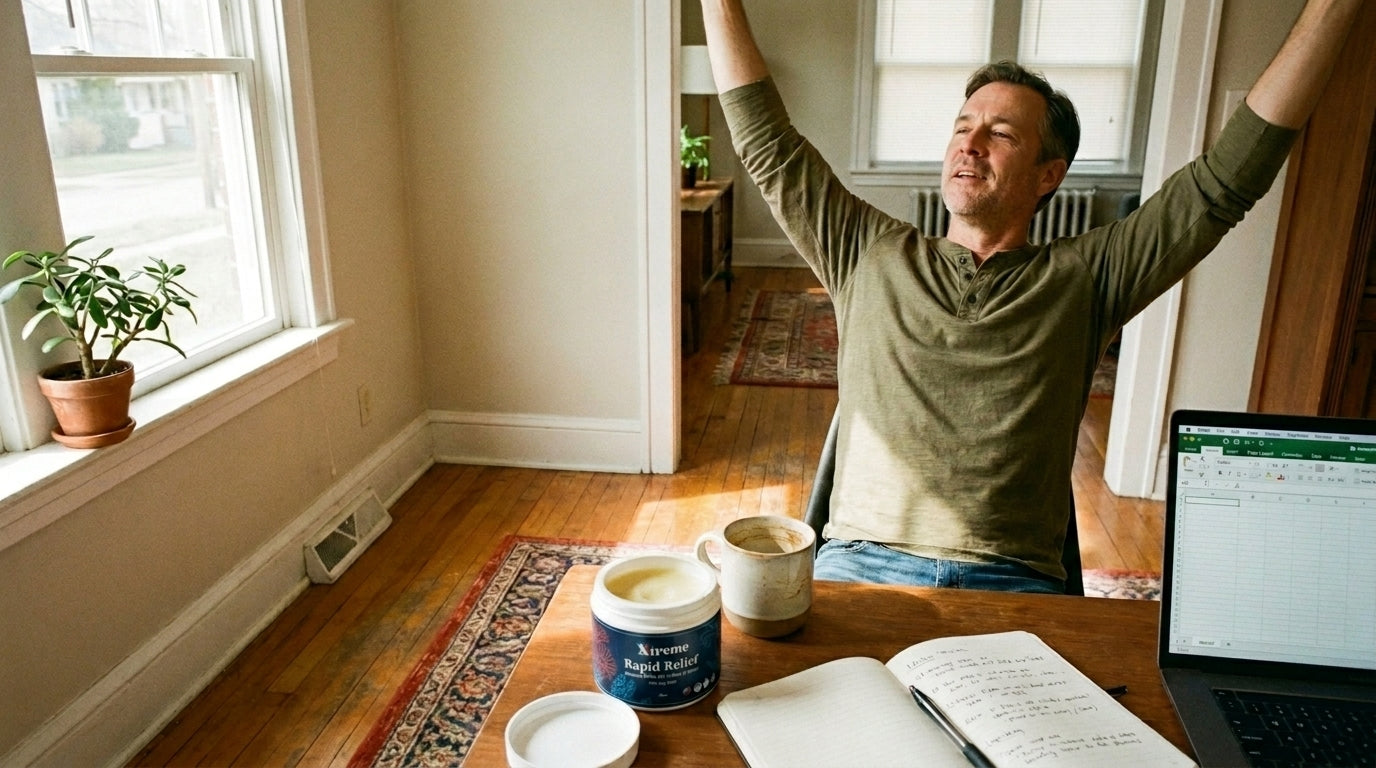
You sit down to answer one email and stand up an hour later with a stiff neck, tight hips, and a back that feels ten years older than it did this morning. Sound familiar? You're not broken. You're just paying the tax that comes with modern life, where most of us sit far more than we move.
Here's the good news. The fix isn't another hour at the gym or a complicated routine you'll quit by Wednesday. It's something researchers and trainers are calling movement snacks, and they're shaping up to be one of the biggest wellness shifts of 2026.
Movement snacks are short, intentional bursts of motion sprinkled through your day. Two minutes of stretching between meetings. A lap around the house before lunch. A few sit-to-stands while the coffee brews. They're small, they're easy, and the research suggests they add up to real change in how your body feels and functions.
However, here's what most articles about movement snacks miss. The reason people stop doing them is rarely motivation. It's stiffness. When your knees ache or your shoulders feel locked, even two minutes of movement sounds like too much. This guide covers both halves of the equation: the movement snacks worth trying, and the simple recovery habits that keep you doing them consistently.
What Are Movement Snacks, Really?
Movement snacks are exactly what they sound like. Small portions of movement, eaten in between the bigger meals of your day. The term comes from the physical therapy world and has been gaining traction across fitness publications, wellness trend reports, and even cancer survivorship research as a counter to how much time most adults spend sitting.
The research on prolonged sitting is sobering. According to the National Institutes of Health, extended sedentary time is independently linked to a range of poor health outcomes, even in people who exercise regularly. Translation: hitting the gym three times a week doesn't undo eight hours of sitting if those eight hours stay completely still.
Movement snacks aren't meant to replace workouts. They're meant to break up the stillness in between. Think of them as the floss to your gym session's toothbrush. Both matter. Neither one cancels out skipping the other.
A movement snack can be almost anything that gets your body out of its frozen desk position. Two minutes of shoulder rolls and neck circles. A walk to the mailbox. Twenty bodyweight squats. Reaching overhead and side bending while you're on a phone call. The point isn't intensity. It's frequency.
Why Movement Snacks Matter More After 45
Here's something nobody tells you about getting into your late 40s and 50s. The stiffness isn't the problem. The stiffness is a message. Your body is telling you that the gap between how much it wants to move and how much you're actually moving has gotten too wide.
Harvard Health has covered this for years: muscle mass naturally declines starting around age 30, and the rate speeds up after 50 unless you actively push back. Lost muscle means less support for joints, which means more tightness, more stiffness, and more of that creaky feeling when you stand up from the couch.
Movement snacks fight this on three fronts at once:
• Circulation. Even brief movement gets blood flowing into the tissues that have been compressed by sitting.
• Joint lubrication. Joints have synovial fluid that only moves when you do. A two-minute movement break is a literal joint refresh.
• Habit reinforcement. The hardest part of staying active in your 50s and beyond is keeping the habit alive. Small daily wins beat big weekly heroics every time.
This is why the idea has caught on with everyone from Gen X desk workers to seniors looking to maintain mobility. It works because it's small enough to actually do.
The Hidden Problem: Stiffness Stops You Before You Start
Most movement snack articles end right about here. They give you a list of exercises and tell you to set a timer. That advice is fine, but it leaves out the real obstacle most people hit by week two.
You go to do your two-minute stretch break and your lower back screams. Your knees crack. Your shoulders feel like they're full of sand. So you skip it. Tomorrow you skip it again. By Friday the whole experiment is over. Hinge Health physical therapists point out this exact issue in their patient work: short bouts of activity only become a habit if your body feels good enough to do them.
This is where daily recovery comes in. Not the kind that requires an ice bath, a massage gun, or a 45-minute mobility class. The kind that fits in a pocket and takes 30 seconds.
When the spots that usually stop you (the lower back, the knees, the shoulders, the feet) feel a little easier, the movement snack actually happens. Then it happens again the next day. That's how a habit takes root.
Building a Movement Snack Routine That Actually Sticks
Here's a simple framework. You don't need to use every piece of it. Pick the parts that fit your day.
1. Pick Three Trigger Moments
Habit stacking works because you attach a new behavior to something you already do. Pick three moments that happen every workday no matter what. Coffee brewing. The end of a meeting. Walking past the kitchen. Those become your movement snack cues.
2. Keep the Menu Short
Don't overthink it. Three options total is enough. A 60-second walk. A round of shoulder rolls and neck stretches. Ten chair sit-to-stands. When choice is simple, follow-through is easy.

3. Pre-Treat the Stiff Spots
This is the step most people miss. Before your morning starts, address the areas that usually give you trouble. A quick application of a recovery topical on the knees, lower back, shoulders, or feet can take the edge off the morning stiffness that derails movement breaks later in the day. The Xtreme Rapid Relief Balm is built for exactly this kind of focal, daily-use support. Massage a thin layer into the spots that tend to lock up first, and your body is already a step ahead by the time you sit down to work.
4. Layer in Inside-Out Support
Topicals work on the surface. Sometimes, the tension lives deeper in that whole-body wired feeling that builds up through a long week. Xtreme Rapid Relief Gummies at 25 mg of hemp-derived CBD per gummy support a calmer baseline so your body settles, which makes movement feel more natural and less like a fight. One in the morning, one in the evening if needed. Simple.
5. Stack the Wins, Not the Reps
Count days, not minutes. If you got a movement snack in today, that's the win. Three snacks of 90 seconds beats one perfect 5-minute session that you skip three days in a row. Consistency wins this game.

Ten Movement Snacks You Can Do in Under Two Minutes
Pull from this list. Mix and match. You don't need to do all of them. The goal is to find three or four that feel good and rotate them into your day.
• Wall pushups. Ten reps against the kitchen counter or the wall by your desk.
• Chair sit-to-stands. Stand up and sit back down ten times. Press through your heels.
• Doorway chest stretch. Arms up on the door frame, lean forward slowly. Hold 30 seconds.
• Calf raises. Twenty slow raises while you brush your teeth or wait for the microwave.
• Neck rolls and shoulder circles. Five each direction. Slow and easy.
• Hip flexor lunge stretch. One leg back, sink the hips forward. Thirty seconds each side.
• Cat-cow stretch. Hands on the desk or counter, round and arch your spine ten times.
• Standing side bends. Reach one arm overhead and lean. Five each side.
• Walking laps. Two laps around the house, the yard, or the parking lot.
• Foot circles and rolls. Especially good if you're on your feet all day. Roll each foot over a ball or a frozen water bottle for a minute.
Common Mistakes That Kill the Movement Snack Habit
A few things tend to derail people who start strong and fade by week two. Knowing these in advance helps you sidestep them.
Going too hard. A movement snack is not a mini-workout. If you finish sweating and out of breath, you went too big. Keep it small enough that doing it doesn't feel like a commitment.
Ignoring the warning signs. If a spot has been feeling tight or cranky for days, putting a movement snack on top of it without any recovery support will probably backfire. This is where pairing motion with a topical like the Rapid Relief Spray (great for hard-to-reach areas like the back and shoulders) keeps small issues from becoming bigger ones.
Waiting until you feel like it. You will not feel like it. That's why you tied the movement snack to a trigger moment in step one. The trigger does the deciding, not your mood.
Skipping the evening reset. If your days are physical, evening is when accumulated tension shows up. A Rapid Relief Gummy after dinner plus a few minutes of slow stretching before bed helps your body settle. Check out our take on simple evening wind-down routines for more on this.
Putting It Together: A Simple Daily Rhythm
Here's what a real day looks like when you put all the pieces together. Adjust it to your life.
Morning. Apply Rapid Relief Balm or Spray to the spots that usually give you trouble. Knees, lower back, shoulders, feet. Whatever your problem area is. This takes 60 seconds and pre-treats the stiffness that would otherwise stop you from moving later.
Mid-morning. First movement snack. Tie it to your second cup of coffee or the end of your first meeting.
Lunch break. A short walk. Even 5 minutes outside resets your nervous system and your circulation.
Mid-afternoon. Second movement snack. Doorway stretch, neck rolls, or a few wall pushups.
Evening. Rapid Relief Gummy if your body feels wound up. A few minutes of slow stretching before bed. Reapply topical to any area that's still talking to you.
That's the whole routine. Two movement snacks. Two recovery moments. Maybe ten minutes total across the whole day. The simplicity is the point.
The Bottom Line
Movement snacks are one of those rare wellness ideas that actually deliver on the promise. They're small enough to do, they add up, and they make a real difference in how your body feels by the end of the day.
The piece most people miss is the recovery side. When you support the spots that usually stop you, the snacks happen. When the snacks happen, your body stays in motion. When your body stays in motion, everything else gets easier.
That's exactly what Xtreme Rapid Relief is built for. Clean, fast-acting recovery tools that fit into real life and help you keep moving. Browse the Rapid Relief lineup to find the pieces that fit your day.
* These statements have not been evaluated by the FDA. This product is not intended to diagnose, treat, cure, or prevent and disease.
Share:
Wellness Gifts for Moms: 7 Picks She'll Actually Use
Tired Feet After 50: The Daily Recovery Routine Podiatrists Recommend