

You're exhausted. You've been exhausted for a while. But you lie down and nothing happens. Your brain clicks on, your body stays wired, and somewhere around 1 a.m. you start doing the math on how many hours you'll get if you fall asleep right now.
Sound familiar? You're not alone, and you're not broken. But you probably are running on a pattern that makes sleeping harder than it needs to be.
The good news is that figuring out how to sleep better doesn't require a prescription or a total life overhaul. It requires understanding what's actually disrupting your sleep and making a few targeted changes that your body can actually respond to. This guide covers exactly that.
Why Can't I Sleep? The Real Reasons Adults Lie Awake
Most people assume they can't sleep because they're stressed or just not tired enough. Sometimes that's true, but the more common culprits are subtler, and they tend to compound each other.
Cortisol is a big one. It's your body's primary stress hormone, and it's supposed to be low at night so melatonin can rise and pull you into sleep. But modern life keeps cortisol elevated well into the evening. Late work emails, screens, an argument you're still chewing on, even a late workout can all push cortisol up at exactly the wrong time. When cortisol is high, melatonin gets suppressed. You feel wired. You can't fall asleep even when you want to.
Then there's the rhythm problem. Your body runs on a circadian clock, a roughly 24-hour internal cycle that governs when you feel sleepy and when you feel alert. That clock is sensitive to light, temperature, meal timing, and activity. When those inputs get scrambled, the clock loses its signal. You stop feeling naturally sleepy at a consistent time, and falling asleep becomes a guessing game.
According to the Mayo Clinic, consistent sleep and wake times are among the most effective tools for resetting your internal clock and improving overall sleep quality. That single habit does more than most supplements or rituals.
And then there's the age factor. If you're in your 40s or 50s, your sleep architecture has already shifted. You spend less time in deep slow-wave sleep. You wake more easily. Hormonal changes, especially for women moving through perimenopause and menopause, can make nights feel unpredictable. None of this is a flaw. It's just how sleep changes, and knowing that helps you work with your body instead of against it.
How to Sleep Better: The Fundamentals That Actually Move the Needle
There is a lot of sleep advice out there. Some of it helps. A lot of it is noise. Here's what consistently works for adults who want to sleep better without turning bedtime into a performance.
1. Pick a Wake Time and Protect It
This is the single highest-leverage change you can make. Your body builds sleep pressure throughout the day, and that pressure releases most effectively when your wake time is consistent. When you sleep in on weekends, you shift your internal clock forward and make Sunday night harder. When you stay consistent, your body starts delivering sleepiness at a predictable time and sleep quality improves on its own.
Start with the wake time. The sleep time usually follows.

2. Get Morning Light Within 30 Minutes of Waking
Natural light in the morning sets your cortisol peak at the right time of day, which in turn sets your melatonin rise at the right time at night. It's a direct signal to your circadian clock. Even five to ten minutes outside, or near a bright window, starts the chain reaction that makes nighttime sleep arrive more naturally.
This is free, takes almost no time, and has a meaningful effect on how to sleep better. Most people skip it entirely.
3. Manage the Evening Cortisol Window
The two hours before bed are your body's natural wind-down window. What you do during that time either supports that process or works against it. Screens emit blue light that delays melatonin. News and social media keep your nervous system activated. Late workouts raise body temperature and cortisol. Heavy meals ask your digestive system to stay working when it should be slowing down.
You don't have to eliminate all of it. But pulling one or two of these back in the evening, especially screens and stimulating content, tends to make a noticeable difference in how quickly you fall asleep.
4. Cool the Room Down
Core body temperature needs to drop slightly for sleep to initiate and deepen. A cool room supports that drop. Most sleep researchers point to somewhere between 65 and 68 degrees Fahrenheit as the sweet spot for adults. If your bedroom runs warm, this single change can improve how fast you fall asleep and how deeply you stay there.
5. Stop Trying to Force It
One of the fastest ways to make insomnia worse is to lie in bed staring at the ceiling, frustrated that sleep isn't happening. That frustration becomes associated with the bed itself, and eventually just getting into bed starts activating your nervous system. If you've been awake for more than 20 minutes, get up, do something calm in dim light, and come back when you feel sleepy. This breaks the pattern that keeps the problem going.

Why Sleep Gets Harder After 40 (And What to Do About It)
If your sleep started shifting somewhere in your 40s, you're not imagining it. Sleep changes as we age in specific, well-documented ways. Understanding them helps you work with what's happening instead of just fighting it.
Deep sleep decreases. Slow-wave sleep, the most restorative phase, naturally declines with age. You wake more easily from lighter sleep stages, which is why a dog barking across the street or a partner shifting in bed can pull you all the way awake at 3 a.m. when it never used to.
Melatonin production slows. Your pineal gland produces less melatonin as you get older, which means the signal that tells your brain it's time to sleep gets quieter. This is partly why older adults often feel sleepy earlier in the evening but then struggle to stay asleep through the night.
The cortisol-sleep relationship tightens. Decades of accumulated stress, irregular schedules, and poor sleep habits can make your HPA axis, the system that regulates cortisol, more reactive. Small stressors that wouldn't have affected your sleep at 30 can now keep you up at 50.
Hormonal shifts add another layer. Estrogen and progesterone play a role in regulating sleep, and as those hormones fluctuate during perimenopause and menopause, nights can become genuinely unpredictable. Hot flashes, night sweats, and anxiety can fragment sleep in ways that have nothing to do with habits.
Research published through Harvard Health notes that women over 55 wake in the middle of the night more frequently than any other demographic, and that the combination of hormonal changes and altered circadian rhythms is a significant driver. Knowing this is happening helps. It means adjusting expectations and building a support system around sleep rather than expecting the same sleep you had at 30.
Natural Support for Sleep: What Helps, What Doesn't

The supplement space around sleep is crowded and confusing. Here's a grounded look at what has real support behind it and where the evidence gets thin.
Melatonin
Melatonin works best as a timing signal, not a sedative. It's most effective when used to shift your sleep window or when your natural melatonin production has declined. For adults whose sleep onset has drifted later, or who wake frequently in the early morning, a low dose taken about 30 to 60 minutes before your target bedtime can help re-anchor the rhythm. Higher doses don't necessarily work better and can produce grogginess the next morning.
CBD
CBD's role in sleep is less about sedation and more about settling the background noise that keeps your nervous system activated. Anxiety, physical tension, and a mind that won't stop running are among the most common reasons adults can't fall asleep. CBD supports the calm that allows sleep to happen more naturally, without the heavy or groggy feeling that some sleep aids produce.
For adults dealing with body tension alongside sleep disruption, this combination, a mind that's quieter and a body that's settled, tends to produce the most noticeable improvement in sleep quality.
Botanicals With Real History

Suanzaoren, also called sour jujube seed, has been used in traditional Chinese medicine for centuries to support calm and ease restlessness at night. Danshen (Rhizoma Salviae Miltiorrhizae) is another traditional botanical that supports the transition into deeper rest. These aren't trendy ingredients. They have long histories of use precisely because they work gently and don't leave people feeling impaired the next day.
What Doesn't Help as Much as People Think
Alcohol is worth calling out directly. It helps many people fall asleep faster, which is why it feels like it works. But alcohol disrupts REM sleep in the second half of the night, which is when much of emotional processing and memory consolidation happens. You wake up having technically slept but not having recovered well. If you drink in the evening and consistently wake at 3 or 4 a.m., that's likely the pattern.
Sleeping pills are another area where the short-term relief often comes at a longer-term cost. Many sleep medications suppress deep sleep stages while producing sedation, meaning you feel unconscious but don't actually recover as well. They can also create dependency patterns that make natural sleep harder over time.
Building a Wind-Down Routine That Actually Works
A wind-down routine is not about doing a list of wellness tasks before bed. It's about giving your nervous system a consistent signal that the active part of the day is done. That signal needs to be reliable enough that your brain starts to associate it with sleep.
The routine itself matters less than the consistency. A 20-minute walk, dimming the lights, reading something low-stakes, a warm shower or bath, all of these work because they lower arousal and drop body temperature at the right time. Pick two or three things you can do most nights and repeat them in the same order.
Where people run into trouble is making the routine too elaborate. If it requires 45 minutes and six steps, you'll skip it when life gets busy. The simpler the routine, the more consistently it runs, and consistency is what makes it work.

How to Sleep Better With Inside-Out Support
Behavioral changes do the heavy lifting when it comes to improving sleep. But for adults dealing with body tension, a mind that won't settle, or sleep that's fragmented despite good habits, adding targeted support to your wind-down routine can help fill the gaps.
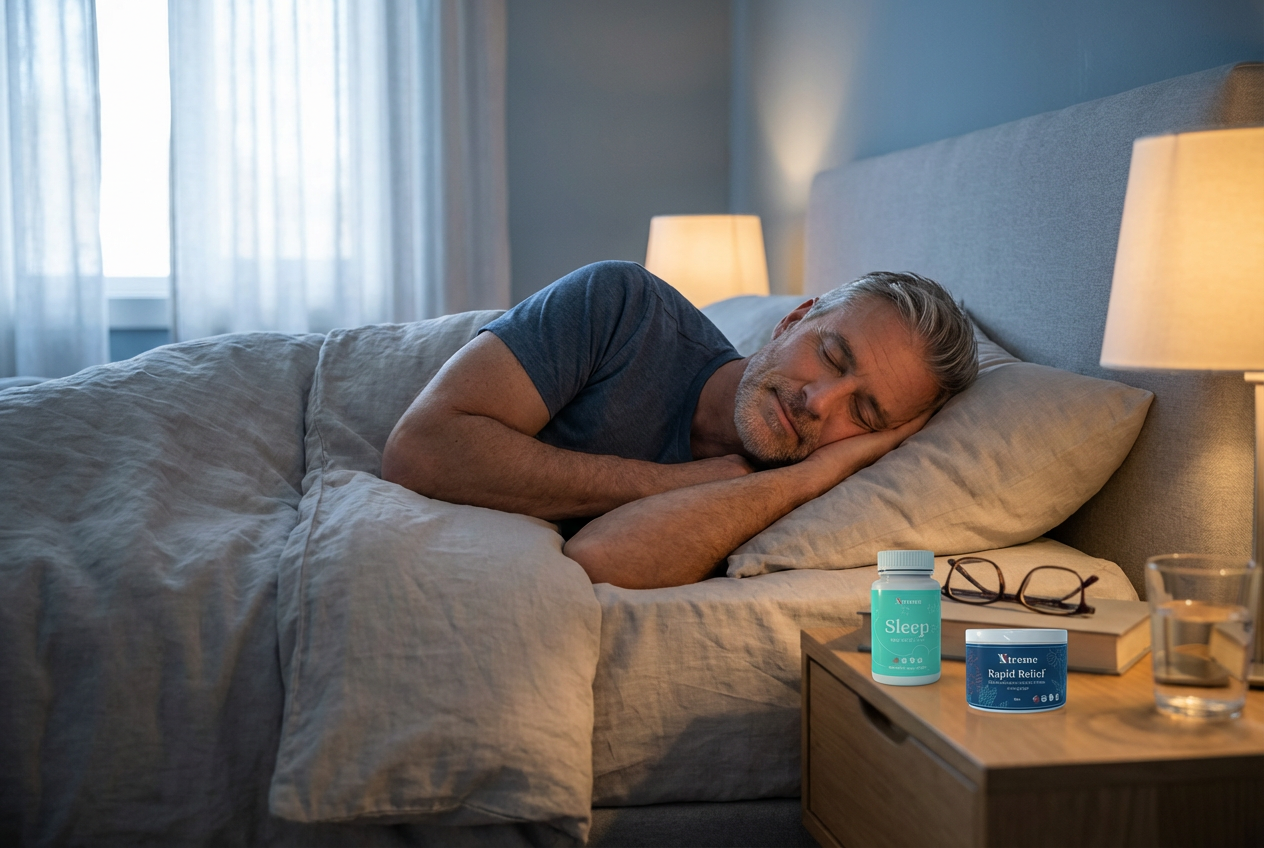
The Xtreme Sleep Softgels are built around this idea. Each softgel combines 25 mg of broad spectrum hemp-derived CBD with 5 mg of melatonin, Suanzaoren, Danshen, and a blend of terpenes including Limonene and Alpha Pinene that support deeper rest and easier transitions into sleep. The formula is designed to calm background tension, support your body's natural melatonin rhythm, and help you move through sleep stages more completely without leaving you groggy in the morning.
For people who also carry physical tension into the evening, combining the Sleep Softgels with the Rapid Relief Balm before bed gives you inside-out support. The balm's all natural botanical ingredients including arnica, turmeric, menthol, and camphor, helps release the surface-level tightness that can keep the body activated when it should be settling. When the body is comfortable, the mind tends to follow.
This is the kind of routine that fits into the two-to-three step routine described above. Take the softgel. Apply the balm where you carry tension. Get into a cool, dark room. That's it.
How to Sleep Better When You Wake Up in the Middle of the Night
Waking up in the middle of the night is different from not being able to fall asleep, and it deserves its own approach.
The first thing to do is not check your phone. Light from the screen signals your brain that it's daytime. Checking the time and doing the math on how many hours you have left activates the prefrontal cortex, the part of your brain responsible for planning and problem-solving, which is the last thing you want running at 3 a.m.
Instead, try a slow breathing pattern. Breathe in for four counts, hold for four, exhale for six to eight. This activates the parasympathetic nervous system and lowers your arousal level. It's simple, requires nothing, and works for many people within a few minutes.
If you're awake for more than 20 minutes and feeling frustrated, the same rule applies as before. Get up, do something calm in dim light, and return when you feel sleepy. The goal is to avoid building a mental association between your bed and wakefulness.
For adults whose middle-of-the-night waking is driven by physical discomfort or tension that builds through the night, addressing that with a topical before bed can reduce the frequency of those wake-ups over time.
A Practical Sleep Improvement Plan by Week
If you want to know how to sleep better in a concrete, structured way, here's a simple progression that builds over four weeks without overwhelming your routine.
Week 1: Set your anchor. Pick a consistent wake time and stick to it every day, including weekends. Get outside or near a bright window within 30 minutes of waking. Do nothing else differently yet. Just establish the anchor.
Week 2: Clean up the evening. Pull screens back 60 minutes before bed. Dim the lights. Stop eating at least two hours before your target sleep time. You don't need a full routine yet. Just remove the biggest disruptors.
Week 3: Add your wind-down. Pick two or three things you can do in the 20 to 30 minutes before bed and repeat them in the same order. Keep it simple. The consistency is the point, not the activities themselves.
Week 4: Fill the gaps. Assess where you're still struggling. If it's falling asleep, the issue is likely still cortisol or light exposure. If it's staying asleep, the issue may be temperature, alcohol, or physical tension. Add targeted support where the gaps remain.
By week four, most adults who follow this progression report noticeably better sleep quality, even if they're not sleeping longer. Quality often matters more than quantity.
You Can Sleep Better. It Just Takes the Right Starting Point.
The biggest mistake most adults make when trying to figure out how to sleep better is adding things before understanding what's getting in the way. You need to remove what's blocking sleep first, then support what's left.
Start with the anchor. Manage the evening window. Build a simple, consistent routine. And if you still need additional support to quiet the body and mind, that's where clean, targeted tools make a real difference.
Sleep is the foundation everything else runs on. When it works, everything else works better too.
Share:
How to Relieve Sore Muscles: What Actually Works
Pickleball Recovery for Sore Knees and Shoulders