
Your neck hurts. Your shoulders are locked up. And you're only three hours into your workday.
If you're spending most of your day staring at screens, you've probably felt it. That dull ache that starts at the base of your skull and spreads across your shoulders. Tech neck isn't just a buzzword. It's a biomechanical pattern that office workers develop when screens pull the head forward and muscles spend eight hours guarding against collapse.
According to research published in the Journal of Physical Therapy Science, prolonged forward head posture significantly increases muscle activation in the upper trapezius and cervical extensors, leading to chronic tension and reduced range of motion. The longer you hold that posture, the more your body adapts to it and the harder it becomes to reverse without intentional intervention.
This post walks through why tech neck relief requires more than stretches or a single product. You'll learn the biomechanics behind the tension pattern, why typical solutions fail desk workers, and how to build a recovery protocol that fits into your actual workday without stopping everything to apply a cream.
The Science of Tech Neck: How Screen Posture Triggers Shoulder Guarding
The biomechanics are straightforward. When your head moves forward, your center of gravity shifts. Your body compensates by pulling your shoulders up and forward to counterbalance the load. That's why tech neck rarely stops at the neck — it pulls the entire shoulder girdle into dysfunction.
The upper trapezius, which runs from the base of your skull to the tops of your shoulders, becomes chronically shortened and overactive. The lower trapezius and serratus anterior — muscles that stabilize the shoulder blades — become weak and inhibited. You end up with an imbalance: some muscles are doing too much, others aren't doing enough, and your body loses the ability to find a neutral resting position.
Harvard Health Publishing notes that this pattern is particularly common in people who use laptops without external monitors or work from couches and kitchen tables. The lower the screen, the more your head has to tilt forward, and the worse the load on your cervical spine.
Here's the part most people miss: stress makes it worse. When you're under mental or emotional stress, your nervous system shifts into sympathetic dominance. Muscles tense up as part of the fight-or-flight response. If you're already dealing with postural tension, stress compounds the problem. Your shoulders creep higher. Your jaw clenches. The muscles that were already overworked get even tighter.
That's why tech neck relief isn't just about addressing the physical tension. You also have to support the nervous system and reduce the stress response that's amplifying the muscle guarding.
Why Typical Solutions Fail Office Workers (Creams, Pills, Stretches Alone)
Walk into any pharmacy and you'll find a wall of topical pain relievers. Most of them are menthol-based creams that provide a cooling sensation on the skin but do very little for the underlying muscle tension. They create a sensory distraction your brain focuses on the cold feeling instead of the pain but they don't promote actual recovery. The moment the menthol wears off, you're right back where you started.
Over-the-counter pain pills work by blocking pain signals in the central nervous system. They're effective for acute pain, but they come with side effects and don't address the root cause. You're just masking the discomfort while the tension pattern continues unchecked.
Stretching helps, but only if you do it consistently and pair it with postural correction. Most office workers stretch for two minutes, feel a little relief, and then sit right back down in the same forward head position. The tension returns within the hour.
What office workers actually need is a protocol that fits into the workday. Something you can apply during a phone call or between meetings. Something that provides felt relief fast enough that you don't have to stop working while it kicks in. And ideally, something that also addresses the stress component driving the muscle guarding.
That's where a multi-format approach combining fast-acting topicals with internal support makes the difference.

Xtreme's Desk-Friendly Application Protocol: Spray During Calls, Balm on Breaks
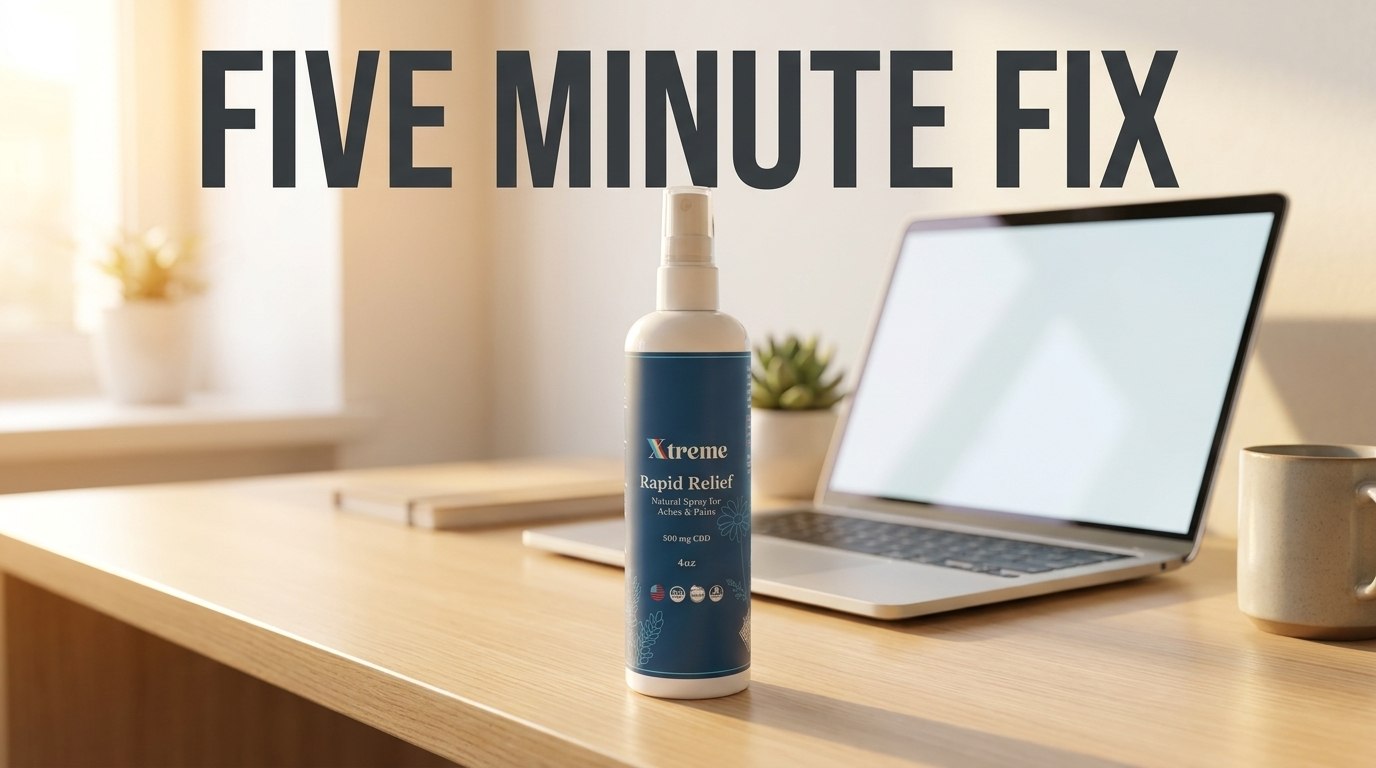
The Rapid Relief Spray was designed for exactly this scenario. It's a mist-on formula that delivers CBD, Arnica, Turmeric, and Devil's Claw directly to the muscle tissue without leaving a greasy residue. You can spray it through your shirt during a Zoom call and no one will know. The cooling-to-warming sensation starts within minutes, and the botanical stack supports circulation and recovery in the underlying tissue.
Here's the 10-second technique: Reach behind your neck and mist the spray along the base of your skull and across the tops of your shoulders. You can apply it through clothing if you're in an office or video call. The formula absorbs quickly and starts working while you keep typing. Most people notice the cooling sensation within three to five minutes, followed by a gentle warming effect as blood flow increases to the area.
For deeper tension — the kind that lives in the meaty part of the trapezius or the knots along the shoulder blade — the Rapid Relief Balm provides more targeted support. The rapid relief formula stays where you put it, which makes it ideal for working into specific trigger points. During lunch breaks or between meetings, take two minutes to massage the balm into the muscle. The CBD and botanical extracts promote circulation and help the muscle tissue release some of the chronic guarding.
The key is consistency. Applying relief once when the pain gets unbearable isn't the same as building a routine. Use the spray throughout the day whenever you feel tension creeping in. Use the balm on your worst trouble spots once or twice a day. Over time, the cumulative effect of improved circulation and reduced inflammation starts to break the tension cycle.
This product is not intended to diagnose, treat, cure, or prevent any disease.

Combining Topicals with Internal Support: How Rapid Relief Gummies Reduce Pain-Amplifying Stress
Here's what most people don't connect: mental stress directly impacts physical tension. When you're stressed, your sympathetic nervous system kicks in. Heart rate increases. Breathing becomes shallow. Muscles tense up in preparation for fight or flight. If you're already dealing with postural tension from screen work, stress compounds the problem.
Research from the American Psychological Association shows that chronic stress contributes to muscle tension, particularly in the neck, shoulders, and back. The body holds stress in these areas, and over time, that pattern becomes habitual. Your muscles forget how to fully relax.
That's where Rapid Relief Gummies come into the picture. These promote calmness and relief from the inside out.
Think of it this way: topicals address the physical tension that's already there. Internal support helps prevent new tension from forming by keeping your nervous system out of fight-or-flight mode. The two approaches work together.
Take one or two Gummies in the morning with your coffee. Use the spray throughout the day as needed. Apply the balm during breaks for deeper tension. That's the protocol. Simple, consistent, and built around your actual workday.

Real Relief Timeline: What to Expect Day 1 vs. Day 21 of Consistent Use
Immediate relief and long-term recovery look different. Here's what to expect.
Day 1: Within minutes of applying the spray, you'll feel the cooling sensation. That's the formula starting to work on the surface. Within 10 to 15 minutes, the deeper warming effect kicks in as circulation increases to the muscle tissue. You'll notice the sharp edge of the tension softens. It's not gone, but it's more manageable. You can get back to work without the constant distraction of discomfort.
Days 3-7: With consistent application — spray throughout the day, balm once or twice daily, Gummies in the morning — you'll notice the tension doesn't build up as quickly. The end of the workday doesn't feel as brutal. Your shoulders don't creep as high. The morning stiffness starts to ease. You're still dealing with the postural load, but your body is recovering better between bouts of tension.
Days 14-21: This is where the cumulative effect becomes obvious. The chronic tightness that used to live permanently in your upper traps starts to release. You catch yourself sitting in a more neutral position without forcing it. The tension that used to require 20 minutes of stretching to touch now responds to a quick spray application. Your range of motion improves. Turning your head to check a blind spot doesn't feel like pulling against a locked joint.
The key is consistency. Relief protocols work when you stick with them long enough for the tissue to adapt. One application won't undo months or years of tension patterning. But three weeks of daily support that addresses both the physical tension and the stress amplifying it can shift the baseline significantly.
If you want the full system from the start, the Essentials Bundle includes the Balm, Spray, and Gummies in one package. It's the three-product starter kit most desk workers find gives them the most flexibility for building a routine that fits their specific pattern.
Total time investment: five minutes spread across the day. No stopping work to stretch for 20 minutes. No excusing yourself to apply a messy cream in the bathroom. Just quick applications that fit into the rhythm of a normal workday.
Share:
Clinical-Strength Recovery at Home: When to Use Xtreme RX Balm vs Xtreme RX Spray in Your Daily Routine
Topical Magnesium for Muscle Recovery and Sleep: How a CBD Magnesium Spray Works Better Together