

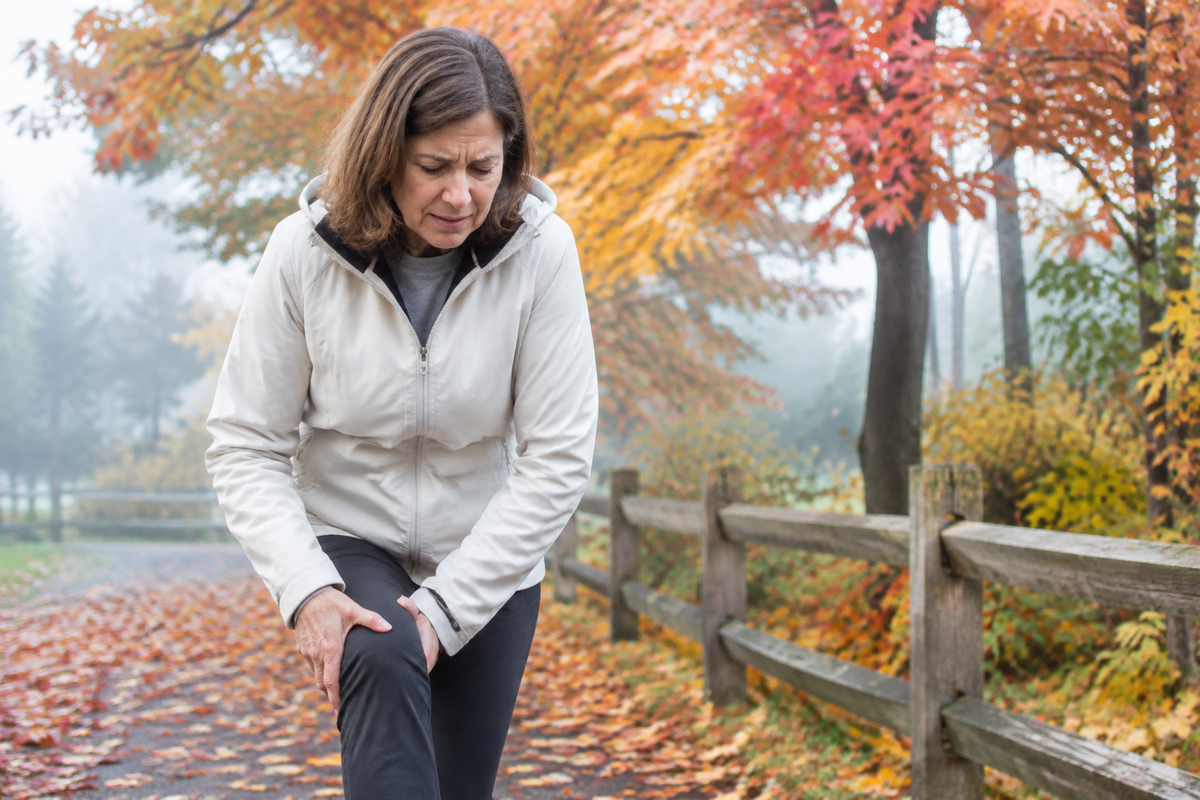
Joint pain due to weather changes is one of the most reported experiences in medicine and one of the hardest issues to address correctly. You will hear everything from "that's definitely real" to "there's no evidence for that" from two doctors in the same building. Here is what is actually known, what is still argued about and what it means for the thing you were planning to do this weekend.
That is the part that matters. Not the ache. The round of golf, the shift, the trail, the grandkid who wants to be picked up. Nobody recovers for the sake of recovering. You recover for what is next.
Is joint pain when the weather changes actually real?
The experience is real. The mechanism is still being argued about.
Millions of people report joint pain when the weather changes, in every climate on earth, consistently, for as long as anyone has been asking. That is a lot of independent witnesses. Large studies have had a harder time isolating a clean cause, which is why you get such different answers depending on who you ask.
Harvard Health lays it out plainly in its breakdown of what triggers weather-related joint pain. Their physicians note that research has not confirmed a definitive cause, then walk through the leading theory in detail. That is the honest version and it is worth reading.
Nobody is imagining this. Joint pain when the weather changes is a real pattern in real bodies. What is unsettled is why.
What is barometric pressure and why do your joints care?
Barometric pressure is the weight of the air pressing on you. It is always there and you never notice it, the way a fish never notices water.
When a system moves in, that pressure drops. Less air pressing in from outside means the tissue around a joint can expand slightly. Tendons, muscle and the soft tissue in and around the joint all get a little more room to swell.
In a joint with plenty of space you would never feel it. In a joint that is tight or worn or carrying an old injury, a small amount of swelling has nowhere to go. That is the barometric pressure joint pain theory in one paragraph. It explains why joint pain when the weather changes lands hardest on the joints you already know by name.
It also explains the timing. Pressure starts falling long before the rain arrives, which is exactly why some people are able to predict the weather a day ahead of it.
Why does it hurt before the storm instead of during it?
The change is the trigger. The weather it settles into matters less than the move from one state to another.
Most people have this backwards. It is not the rain or even the cold causing your joints to hurt. It is the shift. Once a system parks itself and the pressure holds steady, plenty of people report the achiness calms down even though it is still cold and wet out there.
One detail makes this point better than any explanation. Cleveland Clinic's rundown on how changes in weather affect joint pain notes that people in mild San Diego reported more weather-related aching than people in Boston. If raw cold were the villain that makes no sense at all. If change is the villain it makes perfect sense.
Which brings us to fall. September and October are the most volatile stretch of the year in most of the country. Eighty on Tuesday, forty-eight on Thursday. Your joints never get to settle.
Why does the first cold snap hit harder than January?
Everyone braces for deep winter and gets ambushed in October. Joint pain when the weather changes runs on volatility. October has the most of it.
By January the body has adjusted. Two months of layering up, a changed routine, no expectation of feeling the way you felt in July. The first front of the season arrives with none of that in place. You are still running summer settings and the news lands all at once.
Summer also hides things. Warm weather keeps you loose, keeps you moving, keeps you outside. Stiffness that has been building quietly since spring can stay masked right up until the first cold morning. Then it introduces itself.
So cold weather stiffness in October is usually not a new problem. It is an old one that finally got the spotlight.
Is it the cold or is it what the cold talks you out of?
This theory gets the least attention and deserves the most, because it is the part of joint pain when the weather changes that you can actually do something about.
When it is gray and cold you move less. The walk gets skipped. You stay in the chair through the whole game instead of getting up at halftime. You sit more hours in October than you did in June and you never once notice the trade.
Stillness makes joints stiff. That is true at any age in any weather and it happens fast. Sit for ninety minutes, then stand up. The first ten steps feel like somebody swapped your knees out overnight. Now run that pattern for a month.
Harvard's physicians flag this directly. It is the most useful thing in the entire conversation, because behavior is the part you own. You cannot negotiate with a cold front. You absolutely decide whether you get up and move during one.
Does this change as you get older?
Some things stack up. None of them are dramatic on their own.
Cartilage thins gradually across decades, so there is less cushion between the bones. The fluid that lubricates a joint gets thicker and less efficient in the cold. Muscle mass declines slowly after forty unless you are actively working against it. Muscle is what takes load off the joint in the first place.
Put those together and you have a joint with less padding, less lubrication and less support meeting the same pressure swing it met at thirty. Same weather, different equipment. That is why joint pain when the weather changes often shows up as a new complaint in your fifties even though the sky has been doing this your whole life.
That is the honest picture and it is also the encouraging one. Two of those three respond to what you do. Cartilage does not grow back. Muscle absolutely does, at any age. Warm tissue that keeps moving behaves better than cold tissue that does not. Our guide to natural recovery methods for active adults over 40 goes deeper on what actually changes and what to do about it.
Which joints notice the weather most?
Knees, hands and shoulders lead the list when people describe joint pain when the weather changes. The pattern makes sense once you see it.
Knees carry your body weight every day for decades. Hands have dozens of small joints with very little soft tissue around them and they sit at the end of your circulation, so they go cold first and stay cold longest. Shoulders absorb a lifetime of reaching, lifting and sleeping incorrectly.
Hands are where most people notice fall first. Grip goes soft, jar lids get harder, buttons take an extra second. If that sounds familiar, our daily hand recovery routine lays out a short sequence worth stealing.
What actually helps when the weather turns?
Nothing here is exotic. When it comes to joint pain when the weather changes, the boring answers are the ones that hold up.
Move, especially when you do not want to. Every source that studies this lands in the same place. Motion keeps joints lubricated and tissue warm. Ten minutes twice a day beats an hour on Saturday.
Warm up before you go out, not after. Five minutes of easy movement indoors before you hit the cold does more than people expect. Walk the hallway. Roll the shoulders. Open and close your hands.
Dress for the joint, not the thermometer. Gloves at forty-five degrees are not overkill if hands are your weak link. Keeping a joint warm is the simplest thing on this list.
Protect your sleep. Fall wrecks sleep quietly. Dark at five, bed off schedule and recovery takes the hit. Most of the repair work happens overnight or it does not happen.
Read the forecast and get ahead of it. Front coming Thursday? Move more on Wednesday. Treat it like weather you can prepare for, because that is exactly what it is.
Where does a topical fit in?
Topicals earn their spot in a cold weather routine for one reason. They are the part of a routine people actually do, because it takes fifteen seconds standing in the kitchen and you can feel it work. Joint pain when the weather changes rewards the habits that are easy to keep.
The Xtreme Rapid Relief Roll-On was built for the spots that speak up in the fall. Reishi helps calm irritated tissue and support microcirculation. Capsicum Ferment brings gentle warming that helps tight spots let go. The rollerball puts pressure and product down at the same time, which is why it works so well on hands, knees, feet and the back of the neck. It fits in a coat pocket, a glove box or a work bag, which is most of the battle.
For the mornings when it is not one spot, the Xtreme RX Balm goes deeper and stays put. RX is the professional side of our recovery line. It started in doctor offices and became our top seller with customers, largely because people find it once and never go looking again.
Natural is where we start. Effectiveness is the standard. Trust is the part we earn.
If you want to understand the formats before you pick one, our post on topicals for arthritis and joint discomfort breaks down what each is built for.
So what do you do this week?
Pick one thing. That is the whole recommendation for handling joint pain when the weather changes.
If joint pain when the weather changes is part of your October, you already know the pattern and which joints are going to begin aching.
So do something small before the next front. Ten minutes of movement in the morning. A Roll-On in the bag you take to work, Rapid Relief Rx Balm on your nightstand where you will see it. Gloves in the car now instead of in November. None of it is impressive on its own. All of it adds up across a season.
Joint pain when the weather changes may never get a tidy scientific explanation. You do not need one. You need to know what your body does when the weather changes and have a plan for it.
The forecast gets a say in the weather. It does not get a vote in what you do about it.
Whatever your Xtreme is this fall, bring it.
FDA Disclaimer: These statements have not been evaluated by the Food and Drug Administration. This product is not intended to diagnose, treat, cure or prevent any disease.
Share:
How Pro Athletes Recover, and How to Steal It for Everyday Life